Table of Contents
Introduction
An annual maintenance contract for firefighting systems should clearly define the equipment covered, inspection and testing requirements, preventive maintenance activities, service responsibilities, reporting deliverables and exclusions. For factories, warehouses, commercial buildings and industrial facilities, the contract should address the installed systems—not simply promise a fixed number of visits.
Sanskriti Infotech welcomes enquiries relating to firefighting equipment, replacement components and maintenance-related procurement requirements. Its published scope is primarily equipment sourcing and supply; installation, refilling and AMC services are not automatically included. Availability must be confirmed for the specific location and equipment, with the final service scope recorded in the written quotation.
Firefighting Maintenance Enquiries with Sanskriti Infotech
For procurement managers, EHS teams, facility managers and engineering departments, an AMC enquiry often combines two distinct requirements: maintaining installed equipment and procuring the components needed to rectify defects.
Sanskriti Infotech’s fire protection offering supports product sourcing and documentation. Buyers requiring on-site inspection, testing, commissioning or maintenance should request separate written confirmation rather than assume that these services accompany equipment supply.
For an initial enquiry, share:
- Facility address and site contact.
- Installed firefighting systems and asset quantities.
- Equipment manufacturers, models and installation details.
- Existing maintenance records and outstanding defects.
- Required contract duration and proposed start date.
- Whether the requirement is service-only, replacement supply or both.
- Any OEM, consultant or approved-vendor restrictions.
For equipment procurement, visit the fire fighting equipment supply category.
Equipment and Systems to Identify in Your AMC Enquiry
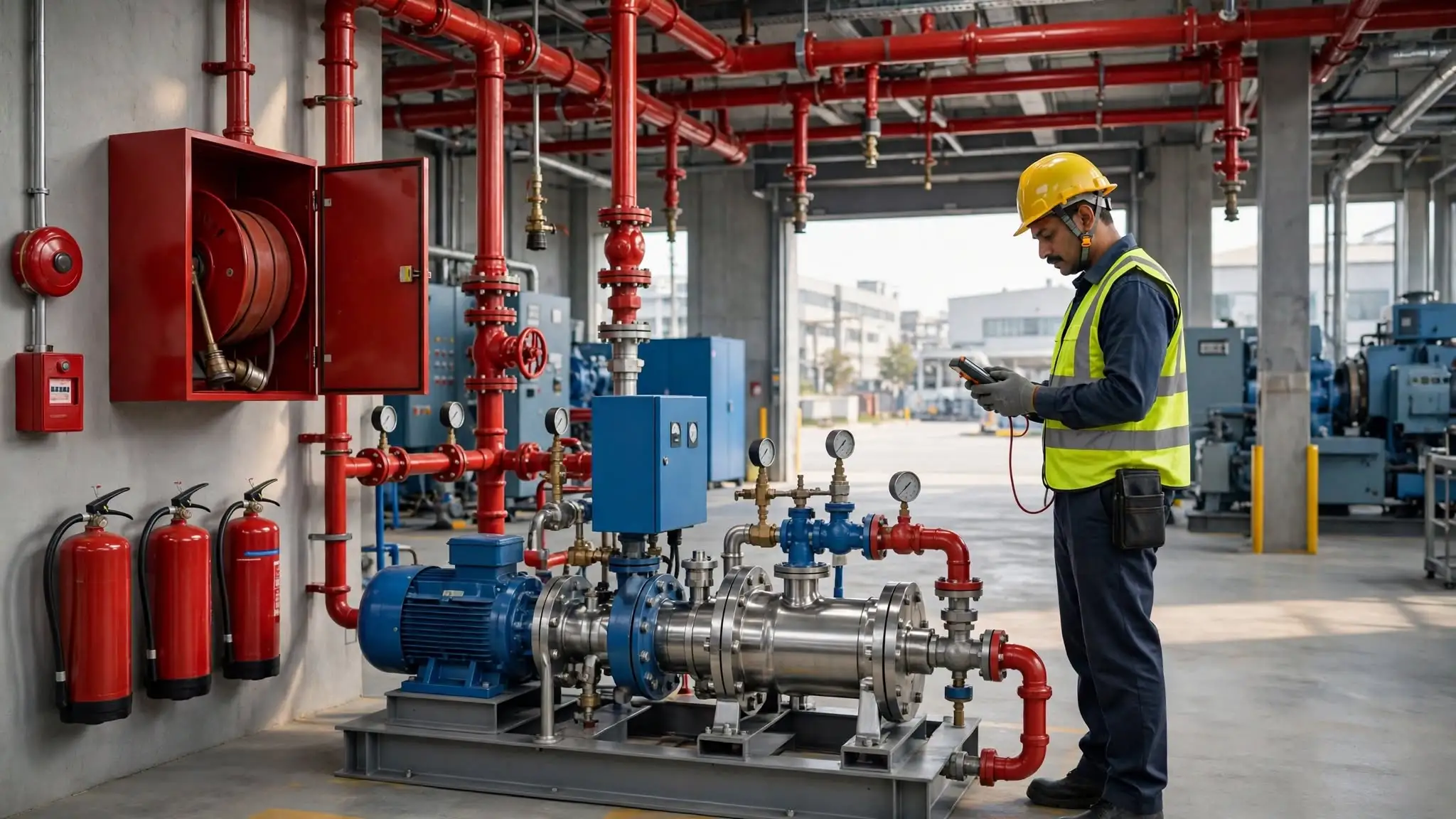
Water-based fire protection systems and fire alarm systems require different maintenance provisions. NFPA 25: water-based system maintenance addresses inspection, testing and maintenance of water-based systems, while NFPA 72: alarm inspection, testing and maintenance includes requirements for fire alarm and signalling system inspection, testing and maintenance. The contract should identify the applicable requirements for each system rather than use one generic checklist.
The following is a proposed enquiry schedule, not a statement of confirmed service availability from Sanskriti Infotech.
| Equipment category | Details to include in the enquiry | Scope to clarify before award |
|---|---|---|
| Fire pumps and controllers | Pump type, duty, drive arrangement, controller make and asset count | Inspection, operational testing, servicing and repair exclusions |
| Hydrant and hose systems | Valve sizes, hose quantities, reels, cabinets and system drawings | Inspection points, testing arrangements and replacement components |
| Sprinkler systems | System type, protected areas, valves and available drawings | Inspection, testing, access requirements and defect reporting |
| Fire alarm and detection | Panel make, model, detector count, zones or loops | Testing coverage, software access, interface checks and OEM support |
| Portable extinguishers | Type, capacity, quantity, location and service history | Inspection, servicing, refilling and replacement scope |
| Special suppression systems | Agent, system manufacturer, protected hazard and cylinder details | Specialist competence, OEM procedures and recharge exclusions |
| Supporting equipment | Emergency lighting, signage and other identified assets | Whether these items are included or separately quoted |
For hydrant-related replacement procurement, buyers can also review fire hydrant system sourcing. Sanskriti Infotech’s published hydrant scope distinguishes product supply from design, installation, testing, commissioning and maintenance.
Technical Specifications, Brands and Replacement Sourcing
Maintenance procurement should identify the exact replacement component wherever possible. A quotation request should distinguish between a like-for-like replacement and a proposed alternative.
Use the following specification format:
| Specification field | Information to provide |
|---|---|
| Existing equipment | Manufacturer, model, serial number and asset tag |
| Component required | Part number, description, quantity and photographs |
| Operating specification | Size, pressure rating, voltage, connection or other relevant parameters |
| Compatibility requirement | Existing panel, controller, valve assembly or system interface |
| Approved sourcing | OEM-only requirement, approved makes or alternatives for review |
| Documentation | Datasheet, warranty, test evidence or other specified documents |
| Delivery requirement | Site address, required date and shutdown dependency |
For engineered suppression systems, Sanskriti Infotech’s published position is that sourcing and documentation support are separate from system design, installation and commissioning, which should remain with the qualified project stakeholder.
Any claimed authorised relationship should be supported for the relevant manufacturer and product range. General multi-brand sourcing should not be described as OEM-authorised servicing without supporting evidence.
Applications and Maintenance Planning
A useful maintenance enquiry explains how the facility operates as well as what equipment is installed. Different access conditions, operating hours and shutdown constraints can change how the proposed work must be organised.
Include relevant site information such as:
- Occupied production areas and restricted-access zones.
- Warehouse operating hours and storage arrangements.
- Pump-room and valve access.
- Availability of drawings and asset registers.
- Permit-to-work and contractor-induction requirements.
- Testing restrictions and authorised work windows.
- Site personnel responsible for witnessing tests.
- Procedures for managing equipment taken out of service.
For water-based systems, NFPA identifies access, building-owner maintenance responsibilities and impairment management as important parts of inspection, testing and maintenance arrangements. These responsibilities should be allocated clearly between the owner, facility team and appointed contractor.
How to Compare Firefighting AMC Proposals
Use a common comparison sheet so that bidders quote against the same asset list, service requirements and exclusions.
Define the Coverage, Not Just the Contract Label
Instead of relying only on descriptions such as “comprehensive” or “non-comprehensive,” request an itemised coverage schedule.
| Contract element | Buyer clarification |
|---|---|
| Planned visits | Number, duration, staffing and activities |
| Inspection and testing | Asset coverage, methods, acceptance criteria and records |
| Preventive maintenance | Included tasks and equipment |
| Breakdown attendance | Coverage hours, response target and escalation route |
| Labour | Included visits, additional visits and specialist attendance |
| Spare parts | Included components, exclusions and approval limits |
| Consumables | Batteries, seals, lubricants and other specified items |
| Refill or recharge | Whether extinguisher refilling or suppression-agent recharge is included |
| Major repairs | Treatment of pumps, motors, controllers, piping and damaged equipment |
| Documentation | Reports, defect registers, test records and closure evidence |
Separate Response from Rectification
Ask bidders to distinguish between acknowledging a complaint, attending the site, diagnosing the fault and completing the repair. Record dependencies such as spare availability, OEM attendance, access permissions and shutdown approval.
Do not describe a contract as offering round-the-clock attendance, guaranteed uptime or a fixed restoration period unless those commitments are explicitly included in the accepted agreement.
Retain Owner Responsibilities
For water-based fire protection systems, NFPA explains that the property owner or designated representative remains responsible for ensuring that inspection, testing, maintenance and impairment management are completed by qualified personnel. Appointing a contractor should therefore be accompanied by clear oversight and reporting arrangements.
Documentation, Standards and Maintenance Records
The contract should identify the standards, manufacturer instructions and project requirements applicable to the installed systems. NFPA 25 provides a reference for water-based system inspection, testing and maintenance; NFPA 72 addresses fire alarm and signalling systems. These references should not be presented as automatic proof that a particular facility meets every local approval requirement.
A proposed documentation schedule can include:
- Baseline asset register and condition assessment.
- Approved maintenance and testing schedule.
- Asset-wise inspection checklists.
- Test results and observations.
- Defect register with recommended corrective action.
- Replacement-part approval records.
- Before-and-after photographs where useful.
- Service reports signed by the designated site representative.
- Outstanding-action tracker.
- Contract-end maintenance summary.
NFPA’s published guidance also distinguishes maintaining an installed sprinkler system from evaluating its original design. An AMC should therefore state separately whether design assessment, system modification or adequacy review is included.
A maintenance report should not be marketed as a fire NOC or an assurance of authority approval.
Bulk Procurement, BOQ and AMC RFQ Process
For multi-building facilities or corporate procurement programmes, organise the enquiry around an asset register and a separate replacement-material BOQ.
Submit Your Maintenance Requirement
Send a scope document containing:
- Facility details and delivery or service locations.
- System-wise asset quantities.
- Existing makes, models and available drawings.
- Required inspections, tests and maintenance activities.
- Proposed contract period and visit requirements.
- Breakdown-support expectations.
- Known defects and pending replacements.
- Required documentation and reporting format.
- Site access, safety and shutdown conditions.
- Commercial terms and vendor-onboarding requirements.
For Sanskriti Infotech, request written confirmation of whether the offer covers equipment supply only or includes any separately agreed services. Its published fire equipment FAQ expressly states that AMC, installation and refilling are not automatically included in product supply.
Request Separate Commercial Schedules
For easier comparison, ask for separate pricing for:
- Planned maintenance labour.
- Breakdown attendance.
- Specialist or OEM attendance.
- Included replacement components.
- Additional materials against approved quotations.
- Refilling or agent recharge, if applicable.
- Travel, access equipment and other stated charges.
- Taxes and payment milestones.
No fixed AMC price is proposed here because the asset list, equipment condition, service location and required coverage have not been established.
Industries and Buyer Teams
This enquiry format can be adapted for:
- Manufacturing and engineering facilities.
- Textile and processing units.
- Warehouses and logistics facilities.
- Commercial buildings and facility-management portfolios.
- Hospitals and institutional premises.
- Chemical and process facilities.
- EPC handover and post-handover procurement.
- Multi-site corporate maintenance programmes.
For wider maintenance-related purchasing, review industrial and electrical safety equipment, including sourcing categories such as lockout/tagout products and electrical safety equipment.
Why Enquire with Sanskriti Infotech?
Sanskriti Infotech provides a route for buyers seeking firefighting products, replacement equipment and related documentation. Its published pages distinguish this supply role from installation, commissioning and maintenance responsibilities, allowing the enquiry to be scoped before an order is placed.
Structure your enquiry around:
- A clearly identified product or replacement requirement.
- The existing system specification and approved makes.
- Required technical documentation.
- Delivery location and procurement timeline.
- Separate confirmation of any requested field services.
This positioning avoids presenting unverified AMC capabilities, emergency attendance or contractor approvals as established services.
Request a Quotation
Contact Sanskriti Infotech to discuss firefighting equipment, replacement-component procurement and the availability of any separately scoped maintenance services.
Email: [email protected]
Phone: +91 9660377250
Enquiry page: Contact Sanskriti Infotech
Ready to enhance workplace safety with engaging visuals? Contact us