Table of Contents
Introduction
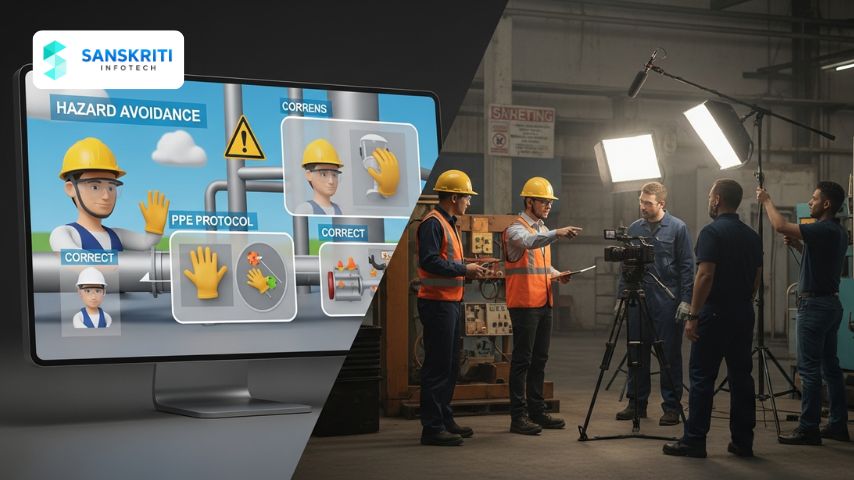
Safety training formats have evolved significantly, and organizations today often evaluate safety animation versus live-action video to determine which delivers better training outcomes. In high-risk industries such as manufacturing, construction, oil and gas, logistics, utilities, and healthcare, the choice of training format directly impacts safety performance, compliance, and return on investment. For benchmark guidance on safety training expectations, see OSHA safety training guidance.
This document provides a practical comparison to help decision-makers choose the most effective approach.
Understanding Safety Animation
Safety animation uses 2D or 3D visuals to simulate hazards, procedures, workflows, and consequences in a controlled environment. It allows organizations to demonstrate dangerous scenarios without exposing workers to real risk. Solutions such as 3D safety animation services are especially valuable when training for critical operations, emergency responses, or complex SOPs.
Understanding Live-Action Safety Training
Live-action safety videos are filmed using real people, real equipment, and actual worksites. They are commonly used for PPE demonstrations, site walkthroughs, and leadership messaging where realism and human connection are essential.
Key Comparison Areas
Hazard Visualization
- Animation visualizes invisible or extreme hazards safely, including explosions, confined spaces, chemical exposure, and high-voltage risks.
- Live action is limited by real-world safety constraints, permits, and what can be filmed without endangering workers.
Accuracy and Consistency
- Animation ensures procedures are shown exactly as intended, frame by frame, aligned with your SOPs and EHS guidelines.
- Live action may vary due to site conditions, worker behavior, changing layouts, and human factors, reducing consistency over time.
Scalability and Reuse
- Animated videos scale easily across sites and regions, and can be localized for different languages and regulations.
- Live-action videos often become site-specific and outdated when equipment, layouts, or processes change, requiring reshoots.
Engagement and Retention
- Animation supports storytelling, simulations, and cause-and-effect learning that helps employees understand “what happens if” they ignore procedures. See research-led perspectives at NIOSH.
- Live action can work well for simple procedures but may feel passive or less clear for complex, multi-step technical tasks.
Cost and ROI
- Animation delivers stronger long-term ROI through reuse, modular updates, and easy adaptation to new standards or sites.
- Live action often requires reshoots when processes, equipment, or branding change, increasing production costs over time.
When Live Action Still Works
Live action is still effective for leadership messages, behavioral safety scenarios, and simple demonstrations where realism and emotional connection are more important than advanced hazard visualization. Examples include CEO safety messages, culture-building campaigns, and simple PPE wear-and-care demonstrations.
Why Organizations Prefer Safety Animation
Many organizations prioritize safety animation because it reduces incidents, improves compliance, shortens onboarding time, and provides consistent training across global operations. It is particularly effective for industries like power and utilities, chemical processing, mining, and data centers, where realistic simulation of high-risk scenarios is essential.
Sanskriti Infotech’s Role in Choosing the Right Format
Sanskriti Infotech supports organizations in choosing and delivering the right safety training format, with strong expertise in 3D safety animation, SOP animation, incident recreation, and digital safety induction. Training strategies are designed to align with ISO occupational health and safety standards and region-specific regulatory expectations such as UK Health and Safety Executive guidance.
Teams typically connect through the Contact Us page to evaluate animation-led safety training strategies tailored to their sites, procedures, and workforce profiles.
Conclusion
Safety animation and live action both have roles in modern training ecosystems. However, for complex, high-risk, and scalable safety training needs, animation delivers superior visualization, consistency, and long-term ROI. By working with specialized partners like Sanskriti Infotech, organizations can balance both formats effectively, building programs that are engaging, compliant, and aligned with evolving safety standards. For broader context on global safety best practices, explore resources from National Safety Council.