Table of Contents
Introduction
Sanskriti Infotech builds custom Learning Management Systems (LMS) for manufacturing, industrial companies, and large enterprises that need more than off-the-shelf training platforms.
Our LMS is purpose-built for shop-floor realities: offline access for deskless workers, compliance automation for OSHA and ISO, multi-site rollouts across global operations, and deep integrations with HRIS, EHS, and operational systems. Whether you run a single factory or a network of plants across continents, our learning management system scales to your complexity.
What is an LMS | Learning Management System?
A Learning Management System (LMS) is software that delivers, tracks, and manages training and development programs across an organization. Modern LMS platforms go far beyond basic course delivery to include compliance automation, certification tracking, competency assessment, skills mapping, and analytics that connect learning to business outcomes.
For manufacturing and industrial companies, an LMS must handle:
- Deskless workers: Training delivery via mobile, kiosk, and offline modes for shop-floor teams.
- Compliance requirements: OSHA, ISO 45001, GMP, FDA 21 CFR Part 11, and industry-specific standards.
- Multi-site operations: Consistent training enforced across plants, shifts, and regions.
- High-risk operations: Safety training, SOPs, incident-based retraining, and competency verification.
- System integrations: HRIS (SAP, Oracle, Workday), EHS platforms, access control, and operational databases.
Sanskriti Infotech’s LMS is built specifically for these challenges—not adapted from a generic corporate training platform.
LMS for Manufacturing: Built for the Shop Floor
Manufacturing companies need an LMS designed for the realities of factory operations: noisy environments, shift work, limited connectivity, and workers who never sit at a desk.
Our LMS for manufacturing includes:
- Shop-floor access: QR codes, NFC tags, and kiosks at workstations for instant training access.
- Offline-first mobile apps: Download modules and complete training without internet connectivity.
- Microlearning modules: 3–5 minute lessons that fit into shift handovers and breaks.
- Multilingual content: Training in the languages your workforce actually speaks (30+ languages supported).
- 3D safety animations: Photorealistic visuals that show hazards, procedures, and consequences.
- Practical assessments: Photo/video uploads, supervisor sign-offs, and skills validation.
- Shift-aware scheduling: Training assigned around production schedules, not during peak output hours.
This isn’t a generic LMS with a manufacturing label. It’s built from the ground up for industrial companies and factories.
Enterprise LMS: Scalable, Secure, Integrated
For large organizations with complex training needs, our enterprise LMS provides the scalability, security, and integrations that corporate training demands.
Enterprise features include:
- Multi-tenant architecture: Separate portals for different business units, regions, or subsidiaries.
- Advanced analytics: Predictive insights on skills gaps, compliance risks, and training ROI.
- AI-driven personalization: Adaptive learning paths based on role, performance, and career goals.
- Extended enterprise: Train not just employees, but contractors, suppliers, dealers, and customers.
- SOC 2 and ISO 27001: Enterprise-grade security for sensitive training data.
- SSO and identity management: Seamless integration with Azure AD, Okta, and other providers.
- API-first architecture: REST APIs, webhooks, and event-driven integrations with CRM, ERP, and talent systems.
Our enterprise LMS supports 500,000+ learners across global deployments with 99.9% uptime SLA.
Key LMS Features for 2026
Modern LMS platforms must deliver more than basic course management. Here are the essential features our learning management system provides:
1. Role- and Team-Based Enrollment
Automatically assign training by job function, department, location, or risk profile to reduce manual workload and ensure the right people get the right training.
2. Adaptive Learning Paths
Structure programs based on skill gaps, progress, or certification status. Learners see personalized recommendations, not generic course lists.
3. Multilingual Content Delivery
Support diverse teams with localized courses, native voiceovers, and responsive mobile access in 30+ languages.
4. Integrated Reporting and Dashboards
Track training completion, performance, and engagement at team, site, and organizational levels with real-time dashboards and exportable reports.
5. Version-Controlled Content
Ensure teams always access the latest materials while maintaining a full revision history for audits and compliance verification.
6. Acknowledgment and Policy Tracking
Collect time-stamped confirmations for SOPs, policy updates, and internal documents with legal-grade audit trails.
7. Support for Multiple Audiences
Deliver training to employees, contractors, partners, or customers from one platform with role-based access and branding.
8. System Integrations
Connect with HRIS (SAP, Oracle, Workday), CRM, EHS platforms, access control, and analytics tools to sync learner data and performance metrics.
9. SCORM and xAPI Compatibility
Support standard content formats (SCORM 1.2, SCORM 2004, xAPI, AICC) so you can use third-party training materials and track detailed learner activity.
10. Scalable Administration
Manage users, content, and settings efficiently across geographies or business units with bulk operations, delegated admin, and multi-domain architecture.
11. AI-Driven Automation
Trigger reminders, assign content, or flag risk areas based on learner behavior, completion patterns, and compliance gaps.
12. Mobile-Responsive Design
Extend learning to frontline and distributed workers without desktop access via iOS and Android apps with offline capabilities.
13. Compliance Training and Certification Management
Automate enrollment, deadline tracking, expiry alerts, and audit-ready completion records for regulated industries.
14. Blended Learning Support (ILT + eLearning)
Support programs that combine live instruction (in-person or virtual) with self-paced eLearning content.
15. Accessibility and Inclusive Design
Meet WCAG 2.1 AA standards to reach underserved learners and comply with accessibility regulations.
LMS for Corporate Training: Enterprise-Grade Learning Platform
For corporate training programs that span multiple business units, regions, and learner populations, our LMS for corporate training delivers:
- Leadership development: Executive coaching, management training, and succession planning modules.
- Compliance automation: POSH, DPDP Act, anti-bribery, data privacy, and industry-specific regulations.
- Onboarding workflows: Automated paths for new hires with role-specific content and manager dashboards.
- Skills matrices: Visual dashboards showing competency gaps by team, site, or function.
- Career pathing: Learning recommendations tied to promotion criteria and succession planning.
- Social learning: Peer discussions, knowledge sharing, and mentor-mentee connections.
- Gamification: Badges, leaderboards, and rewards to boost engagement and completion rates.
This is corporate LMS design that connects learning to business strategy, not just compliance checkboxes.
LMS Development: Custom-Built for Your Needs
Not every organization fits a standard LMS template. Sanskriti Infotech provides custom LMS development for organizations with unique requirements.
Our custom LMS development includes:
- Requirement discovery: Deep dive into your workflows, compliance needs, user populations, and integration requirements.
- Architecture design: Microservices-based, cloud-native design with scalability and security built in.
- UI/UX design: User-friendly interfaces for administrators, managers, and learners across web and mobile.
- Custom feature development: Unique workflows, assessments, certifications, and integrations specific to your business.
- Content migration: Transfer existing courses, SCORM packages, and training records from legacy systems.
- Testing and QA: Functional, security, performance, and user acceptance testing before launch.
- Deployment and support: Cloud or on-premise deployment with 24/7 support and continuous improvement.
We’ve delivered 150+ custom LMS projects for manufacturing, healthcare, finance, education, and government sectors.
Enterprise LMS Development: Complete Guide for Corporate Success
Building an enterprise LMS requires careful planning across multiple dimensions:
1. Multi-Unit Segmentation and Role Management
Enterprises often support multiple business units, geographies, and learner populations. The platform must allow segmentation of roles, data visibility, branding, and access.
2. Advanced Analytics and Dashboards
Training teams must report on learner performance, certifications, time to competence, and business impact. Out-of-the-box reporting rarely cuts it.
3. Identity Management and Single Sign-On
Working with HRIS, directory services (Azure AD, Okta), and identity providers is non-negotiable for many corporates.
4. API-First Architecture
If you plan to connect your LMS to CRM, ERP, talent systems, and content libraries, you need flexible APIs and event architecture.
5. Content Standards Support (SCORM/xAPI/Certifications)
Training has to be tracked, audited, and often compliant in regulated sectors with standardized content formats.
6. Localization and Multiple Languages
If you operate globally, you’ll need multi-language support, time zones, and region-specific compliance modules.
7. Role-Based Access and Compliance Workflows
Audits, certificates, expiry, renewal: key for industries like finance, health, and manufacturing.
8. Content Governance and Lifecycle
Publishing, versioning, retirement of content, tracking author changes, and managing third-party libraries.
9. Mobile Learning and Offline Access
Learners expect flexibility; training must happen when and where they are, including offline scenarios.
10. Personalization and Growth Paths
More than “see a list of courses”; modern systems suggest next steps, track progression, and adapt to skill gaps.
Sanskriti Infotech addresses all ten dimensions in our enterprise LMS development engagements.
LMS for Manufacturing Safety Training: OSHA-Ready
For manufacturing safety training, our LMS provides OSHA-ready capabilities:
- OSHA course library: Pre-built modules for general industry, construction, and specific hazards.
- Automated assignments: Training assigned based on role, site, and risk exposure.
- Completion tracking: Real-time dashboards showing who has completed required safety training.
- Audit-ready reporting: Exportable records for OSHA inspections and internal audits.
- Incident correlation: Analytics connecting training completion to safety performance and near-miss trends.
- Multilingual delivery: Safety training in languages workers understand best.
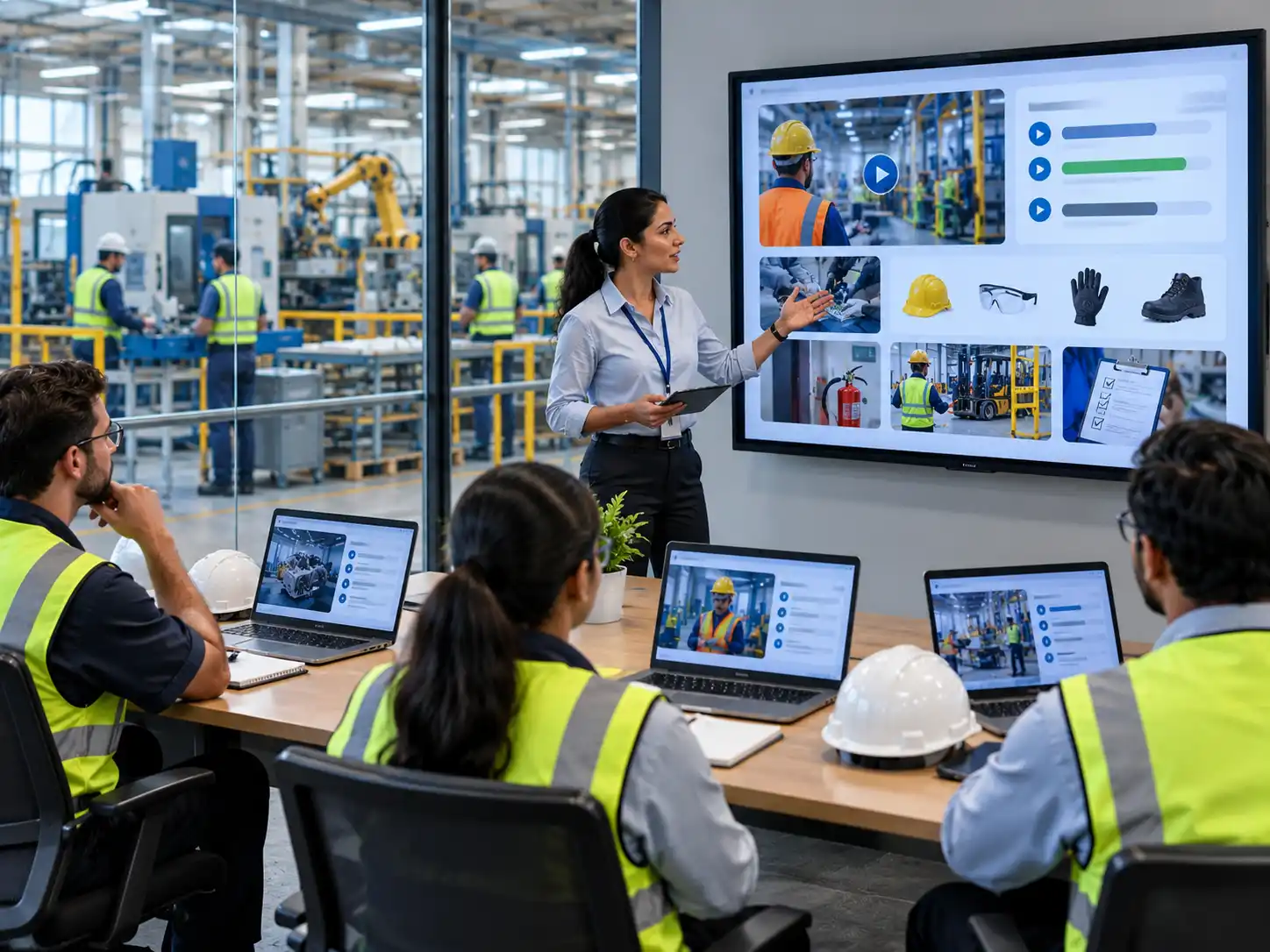
- Mobile and kiosk access: Training on the shop floor, not just in conference rooms.
This is LMS for manufacturing safety training that reduces incidents, not just checks boxes.
Why Choose Sanskriti Infotech for LMS?
1. Manufacturing DNA
We specialize in manufacturing, industrial companies, and high-risk sectors. Our team includes former plant managers, EHS professionals, and instructional designers who understand your world.
2. End-to-End Ownership
We handle everything: custom LMS development, safety content creation, 3D animation production, SCORM packaging, HR/EHS integrations, cloud deployment, and ongoing support.
3. Proven at Scale
Our platforms support over 500,000 learners across manufacturing, oil and gas, chemicals, construction, healthcare, and power sectors globally.
4. India-Centric, Globally Deployed
Headquartered in Surat, India, we combine local expertise with global delivery capabilities across North America, Europe, Middle East, Asia Pacific, and Africa.
5. Measurable Outcomes
Our clients report:
- 50–70% reduction in safety incidents
- 90%+ training completion rates
- 40–60% faster audit preparation
- 30–50% reduction in training administration costs
- Zero non-conformities in ISO and OSHA audits
Technical Specifications
| Feature | Specification |
|---|---|
| Architecture | Microservices-based, cloud-native |
| Scalability | 500,000+ concurrent users |
| Security | SOC 2 Type II, ISO 27001, GDPR, HIPAA-ready |
| Standards | SCORM 1.2, SCORM 2004, xAPI, AICC |
| Integrations | SAP, Oracle, Workday, Azure AD, Okta, REST APIs |
| Mobile | iOS, Android, offline-first, kiosk mode |
| Languages | 30+ with native voiceovers |
| Uptime SLA | 99.9% with disaster recovery |
| Support | 24/7 across time zones |
| Deployment | Cloud (AWS, Azure, GCP) or on-premise |
Ready to Transform Your Learning Management System?
If you’re settling for generic LMS platforms that don’t understand shop-floor realities, compliance complexity, or enterprise integration needs, it’s time to upgrade.
Sanskriti Infotech builds the best LMS for manufacturing, industrial companies, and enterprises—custom, scalable, and proven in the world’s most demanding environments.
Let’s build your LMS.
Contact us today for a confidential consultation, platform demo, or custom proposal tailored to your learning and development needs.
Ready to enhance workplace safety with engaging visuals? Contact us