Table of Contents
Introduction
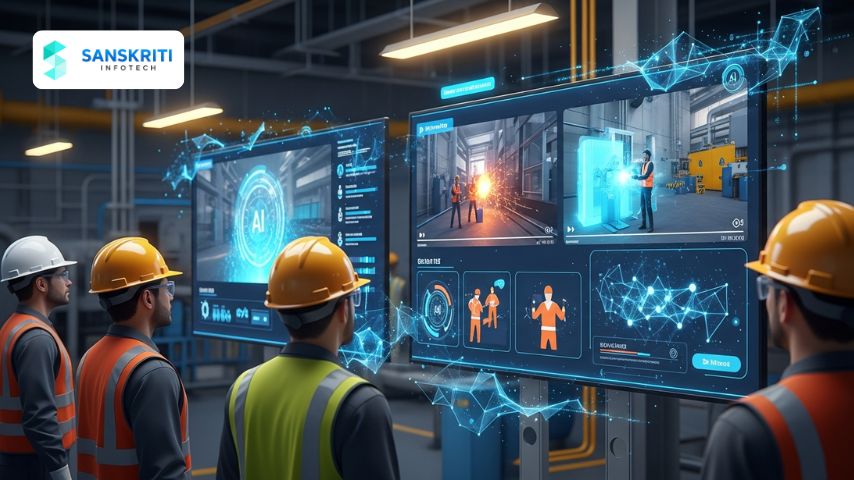
AI-based safety training is emerging as a practical solution for organizations that struggle to keep workforce training effective, current, and scalable. Traditional safety training programs depend on static content, fixed schedules, and one-size-fits-all delivery. These approaches often fail to reflect how work actually happens on the ground.
For EHS leaders, operations heads, and learning teams, the challenge is not a lack of policies or SOPs. The real issue is whether people understand risk, remember controls, and make the right decisions under real operating conditions. AI-driven safety training focuses on adaptive learning rather than one-time instruction.
Why Traditional Safety Training Is No Longer Enough
Many organizations invest heavily in safety training yet see limited improvement in outcomes.
- Training content becomes outdated quickly
- Employees complete courses but forget key controls
- Contractors receive inconsistent induction
- Classroom sessions do not scale
- Learning is disconnected from real risk exposure
AI-based safety training is designed to respond to these structural limitations. Learn more about custom software development for safety training solutions.
What AI-Based Safety Training Actually Means
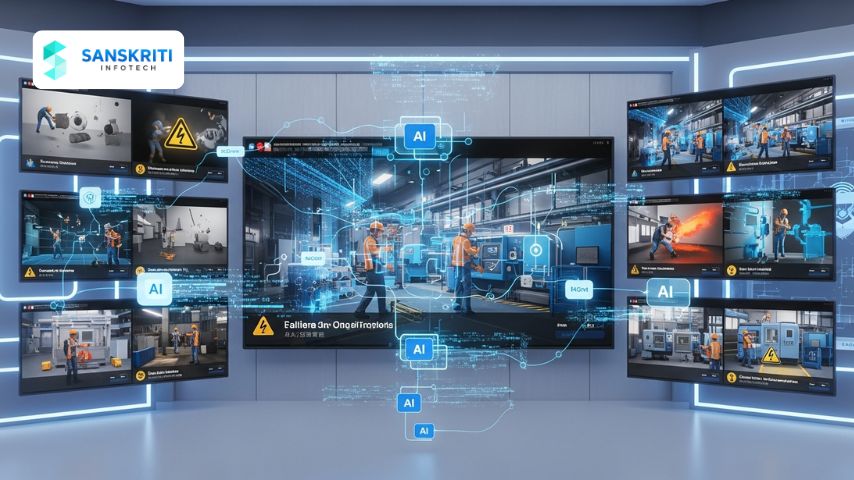
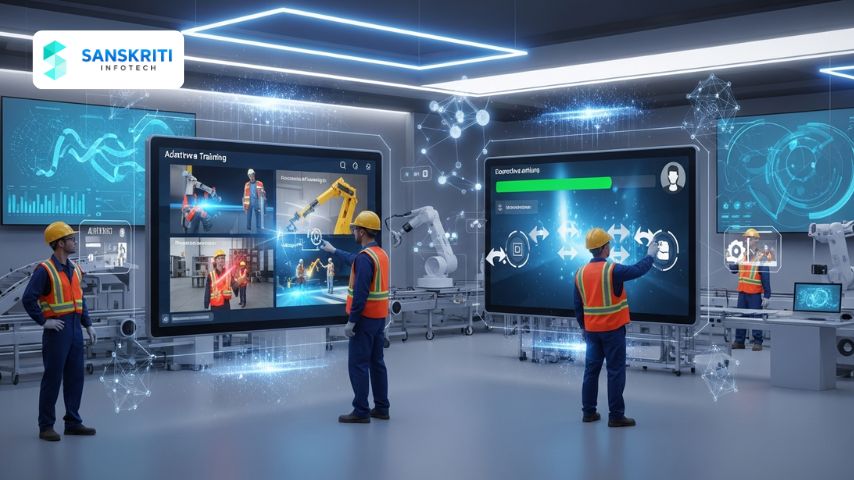
AI-based safety training uses artificial intelligence to adjust how training is delivered, reinforced, and updated over time.
Key capabilities include:
- Role-based learning paths
- Adaptive content frequency
- Scenario-driven safety education
- Automated updates linked to SOP changes
- Analytics-driven improvement
This approach shifts safety training from static instruction to continuous learning. Explore how 3D animation complements AI training systems.
How AI Learning Systems Improve Safety Retention
Retention is the weakest point of traditional safety training.
AI learning systems improve retention by:
- Repeating critical concepts at the right intervals
- Using realistic scenarios instead of abstract rules
- Adjusting content based on user behavior
- Reinforcing learning after incidents or near misses
- Supporting micro-learning formats
Practical Applications of AI-Driven Safety Training
AI-driven safety training is used across daily operations.
- Employee onboarding and induction
- Contractor safety training
- Hazard awareness programs
- Refresher training for high-risk tasks
- Office and industrial safety learning
Because content adapts, training remains relevant long after initial completion. See industry-specific applications in manufacturing and oil & gas.
Using AI-Based Safety Training for Compliance
Compliance programs benefit when training remains aligned with current requirements.
AI-based safety training supports compliance by:
- Reflecting the latest procedures
- Standardizing learning across sites
- Reducing manual update errors
- Supporting audit documentation
- Demonstrating continuous improvement
Training Large and Distributed Workforces
Large organizations face constant training demand due to workforce changes.
AI learning systems help by:
- Delivering consistent training across locations
- Supporting multilingual workforces
- Reducing dependence on instructor-led sessions
- Providing just-in-time learning
- Scaling without proportional cost increases
Learn about cloud services for distributed training scalability.
Governance and Accuracy in AI-Based Safety Training
AI does not remove responsibility from EHS teams.
Strong governance includes:
- EHS-led content approval
- Alignment with SOPs and risk assessments
- Clear ownership of training logic
- Version control and documentation
- Regular review against incidents and audits
Business Impact of Smart Safety Training
Organizations adopting smart safety training models see measurable benefits.
- Improved training retention
- Faster rollout of updates
- Reduced administrative burden
- Fewer repeat incidents
- Stronger safety culture indicators
The Future of AI-Based Safety Training
AI-based safety training is evolving toward predictive and proactive learning systems.
Future developments include:
- Risk-triggered training delivery
- Personalized safety learning paths
- Integration with digital EHS platforms
- Predictive analytics for training needs
- Continuous learning ecosystems
Why Organizations Choose Sanskriti Infotech
Sanskriti Infotech delivers AI-based safety training systems designed for accuracy, adaptability, and scale.
Organizations partner with Sanskriti Infotech because:
- Sanskriti Infotech combines AI with EHS domain expertise
- Sanskriti Infotech builds adaptive learning systems, not static content
- Sanskriti Infotech supports enterprise and regulated environments
- Sanskriti Infotech focuses on long-term learning outcomes
- Sanskriti Infotech operates as a safety training technology partner
Explore our process productivity improvement services for enhanced safety outcomes.
Ready to modernize your safety training with AI-driven solutions? Contact Sanskriti Infotech to discuss your needs.