Table of Contents
Introduction
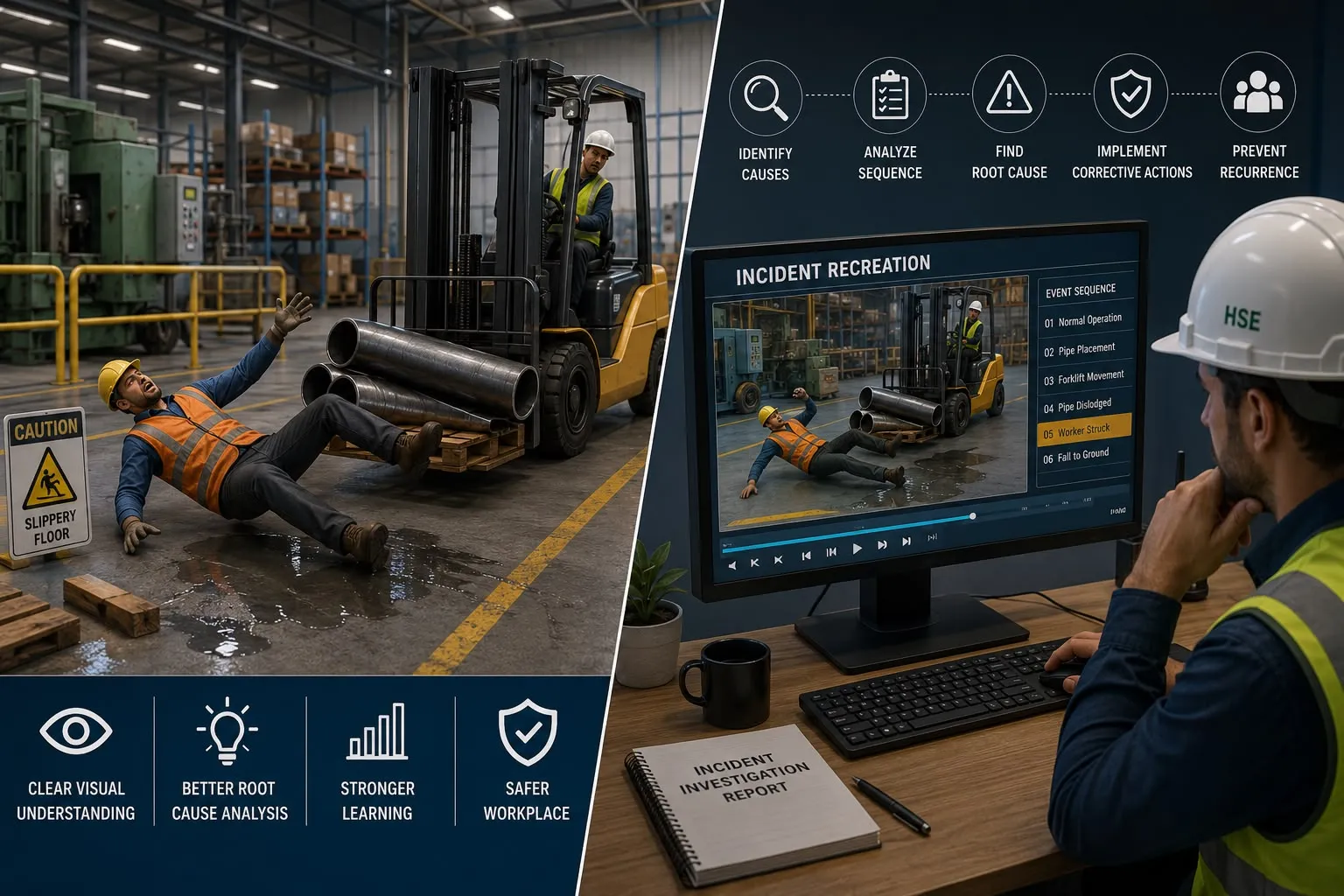
Incident recreation animation helps companies understand what went wrong in a workplace accident by visually recreating the event step by step. For organizations that want stronger root cause analysis, better safety learning, and clearer incident communication, this format is often more effective than text-only reports.
When an accident is recreated in animation, teams can see site conditions, worker movement, equipment behavior, and the sequence of events in a controlled and easy-to-review way. That makes it easier to identify contributing factors, share lessons with employees, and improve future prevention efforts.
Why Incident Recreation Matters
Workplace accidents are often difficult to explain using only words or static images. A report may identify the cause, but it may not show how the situation unfolded in real time. Incident recreation animation fills that gap by showing the event sequence visually, which helps HSE teams, supervisors, and leadership reach a shared understanding.
This matters because many incidents are not caused by one single mistake. They often involve a mix of site conditions, human actions, equipment behavior, and procedural gaps. A visual recreation helps teams see those interactions more clearly, which improves the quality of investigation and the quality of learning that follows.
What Incident Recreation Animation Is
Incident recreation animation is a safety visualization method used to reconstruct workplace accidents, near misses, or unsafe events. It is commonly used during incident investigation, root cause analysis, safety audits, learning reviews, and management presentations.
Unlike a general training video, this type of animation focuses on a real event. It shows the environment as it existed, the actions that were taken, and the chain of events that led to the incident. That makes it especially useful for accident investigation animation, because teams can study the event without revisiting the hazardous situation itself.
How It Supports Root Cause Analysis
Root cause analysis depends on understanding what actually happened, not just what the final report says. Incident recreation animation supports that process by turning witness statements, photographs, site measurements, and timeline data into a visual reconstruction.
This helps investigators compare the intended process with the actual process. They can see whether there was unsafe access, poor positioning, a missing control, a procedural gap, or a communication failure. That visual clarity often leads to better discussion and stronger corrective action planning.
Common Uses in Industry
Incident recreation animation is useful in manufacturing, construction, logistics, oil and gas, and heavy industry. Sanskriti Infotech’s published materials show this approach being used for RCA case studies, construction safety, workplace safety videos, and formal safety animation services, which confirms its relevance across industrial environments.
Typical use cases include:
- Root cause analysis support.
- Accident investigation animation.
- Near-miss recreation.
- Safety training after an incident.
- Management review presentations.
- Compliance and audit support.
- Lessons-learned campaigns.
What a Good Recreation Includes
A strong incident recreation animation should be based on factual inputs such as site photographs, witness statements, incident reports, equipment details, and timeline notes. The goal is not dramatic effect; it is accurate reconstruction for learning and prevention.
A useful deliverable usually includes:
- 3D recreation of the location.
- Worker and equipment movement.
- Hazard sequence visualization.
- Safe-versus-unsafe action comparison.
- Voiceover or captions for clarity.
- A version suitable for internal review and training.
Benefits for Safety Teams
Incident recreation animation gives safety teams several practical advantages. First, it helps them communicate incident details clearly to workers, supervisors, and management. Second, it creates a reusable learning asset that can be used in toolbox talks, refresher sessions, and incident review meetings.
It also helps reduce emotional distance from the event. In many workplaces, discussing a serious accident can be difficult. Animation allows teams to analyze the event in a structured way without relying on graphic images or confusing descriptions.
Why Sanskriti Infotech Is Relevant
Sanskriti Infotech already positions incident recreation animation as part of its safety animation services, including root cause analysis and compliance-oriented use cases. Its published case-study style content shows the company recreating exact site conditions to uncover contributing factors and support learning.
That makes Sanskriti Infotech a relevant partner for organizations that need accident investigation animation, not just general safety graphics. Its industrial safety focus and related content on workplace safety videos, construction safety, and manufacturing safety animation strengthen that fit.
Comparison Table
| Area | Text-Only Investigation | Incident Recreation Animation |
|---|---|---|
| Understanding sequence | Moderate | Strong |
| Site condition clarity | Limited | Strong |
| Stakeholder alignment | Slower | Faster |
| Training reuse | Low | High |
| Support for lessons learned | Moderate | Strong |
| Support for RCA reviews | Good | Very strong |
This comparison is one reason many organizations are shifting toward visual reconstruction for serious or recurring incidents.
Ready to enhance workplace safety with engaging visuals? Contact us